

Whether you’re playing casually with friends or preparing for a competitive game, learning how to rack pool balls correctly is one of the most important skills in billiards. A properly arranged rack creates a fair break, keeps the game consistent, and follows official rules. On the other hand, a loose or incorrect rack can lead to poor breaks, unfair advantages, and unnecessary disagreements.
The good news is that racking pool balls isn’t difficult once you understand the basic patterns for each game. Whether you’re playing 8-ball, 9-ball, or 10-ball, this guide will walk you through everything you need to know.
Why a Proper Rack Is Important
Many beginners focus only on making shots, but experienced players know that the game actually starts before the break. A tight, well-built rack allows energy from the cue ball to transfer evenly through the balls.
A proper rack helps:
- Create a fair and consistent break
- Prevent gaps between balls
- Improve ball movement
- Reduce disputes during games
- Follow official tournament rules
Taking an extra few seconds to build a solid rack can improve every game you play.
Equipment You’ll Need
Before setting up the balls, gather the necessary equipment.
You’ll need:
- A pool table
- A complete set of pool balls
- A triangle rack (for 8-ball)
- A diamond rack (for 9-ball or 10-ball)
Most home and commercial pool tables include these accessories.
Understanding the Foot Spot
Before arranging the balls, locate the foot spot on the table.
The foot spot is the small mark near one end of the table where the rack is placed. The front ball (called the apex ball) should sit directly over this spot.
Correct placement ensures every game begins from the proper position.
How to Rack Pool Balls for 8-Ball
8-ball is the most popular version of pool.
Here’s the correct setup:
Step 1: Place the Apex Ball

Position the number 1 ball at the very front of the triangle directly on the foot spot.
Step 2: Put the 8 Ball in the Center
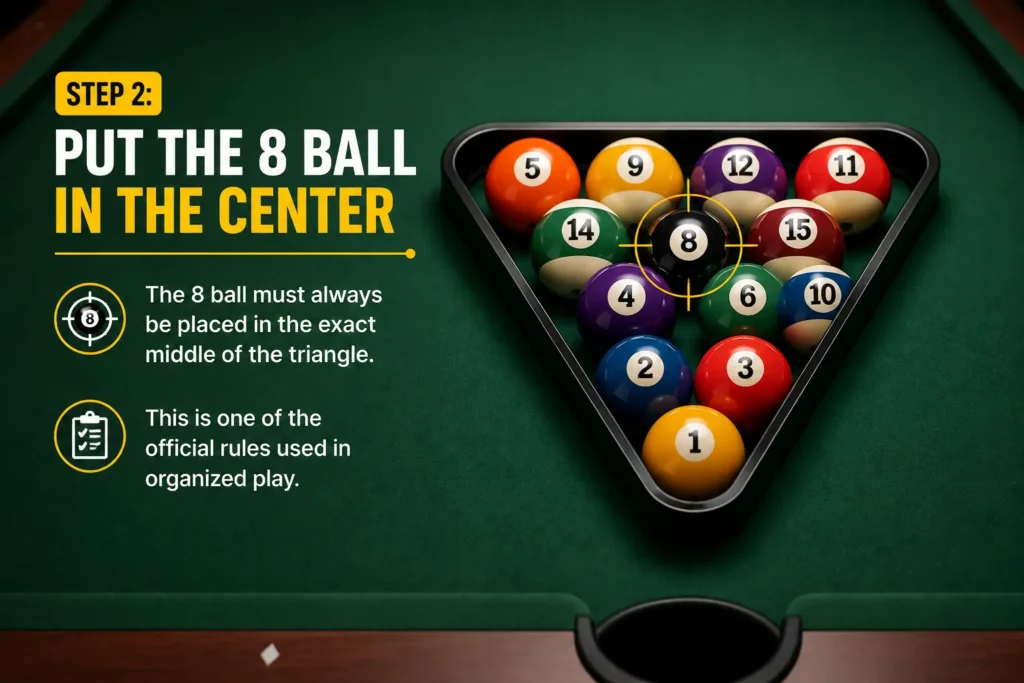
The 8 ball must always be placed in the exact middle of the triangle.
This is one of the official rules used in organized play.
Step 3: Alternate Solids and Stripes
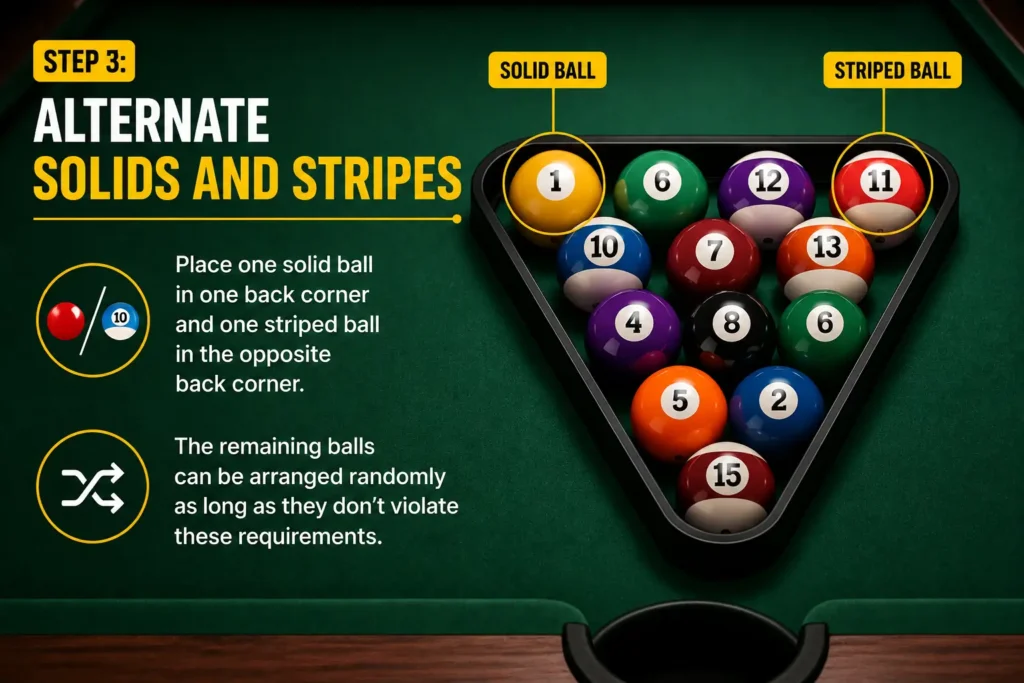
Place one solid ball in one back corner and one striped ball in the opposite back corner.
The remaining balls can be arranged randomly as long as they don’t violate these requirements.
Step 4: Push the Balls Together
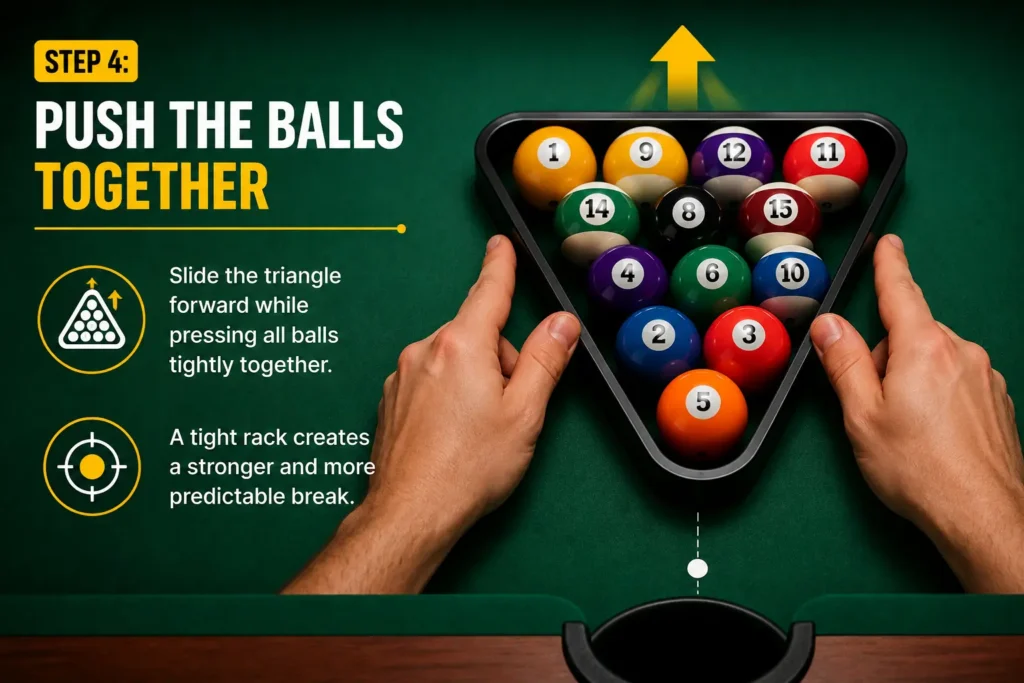
Slide the triangle forward while pressing all balls tightly together.
A tight rack creates a stronger and more predictable break.
How to Rack for 9-Ball
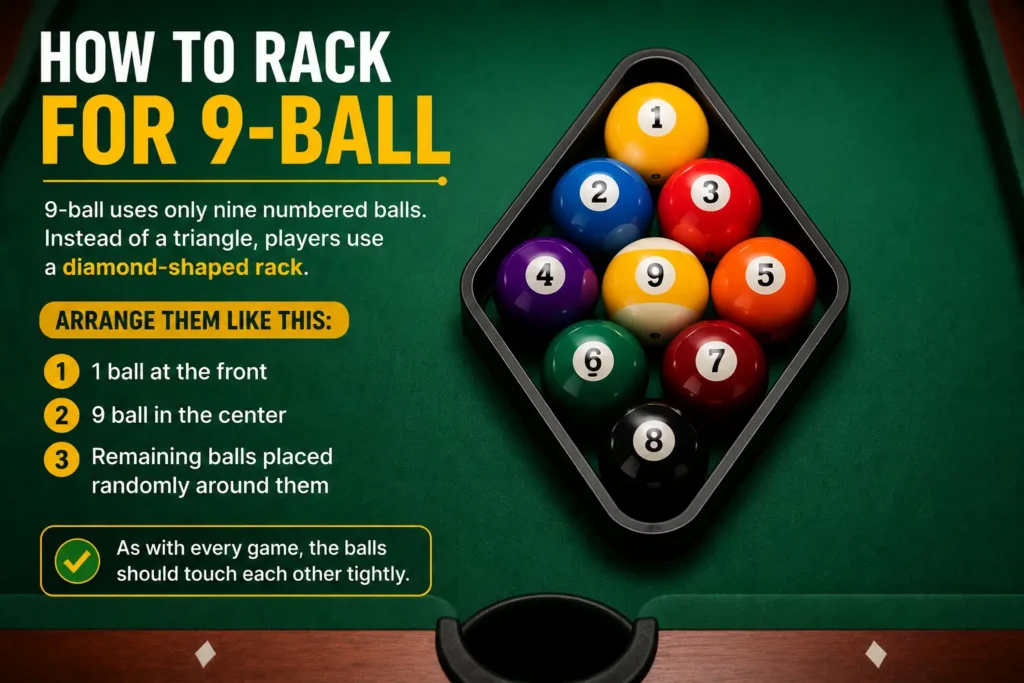
9-ball uses only nine numbered balls.
Instead of a triangle, players use a diamond-shaped rack.
Arrange them like this:
- 1 ball at the front
- 9 ball in the center
- Remaining balls placed randomly around them
As with every game, the balls should touch each other tightly.
How to Rack for 10-Ball
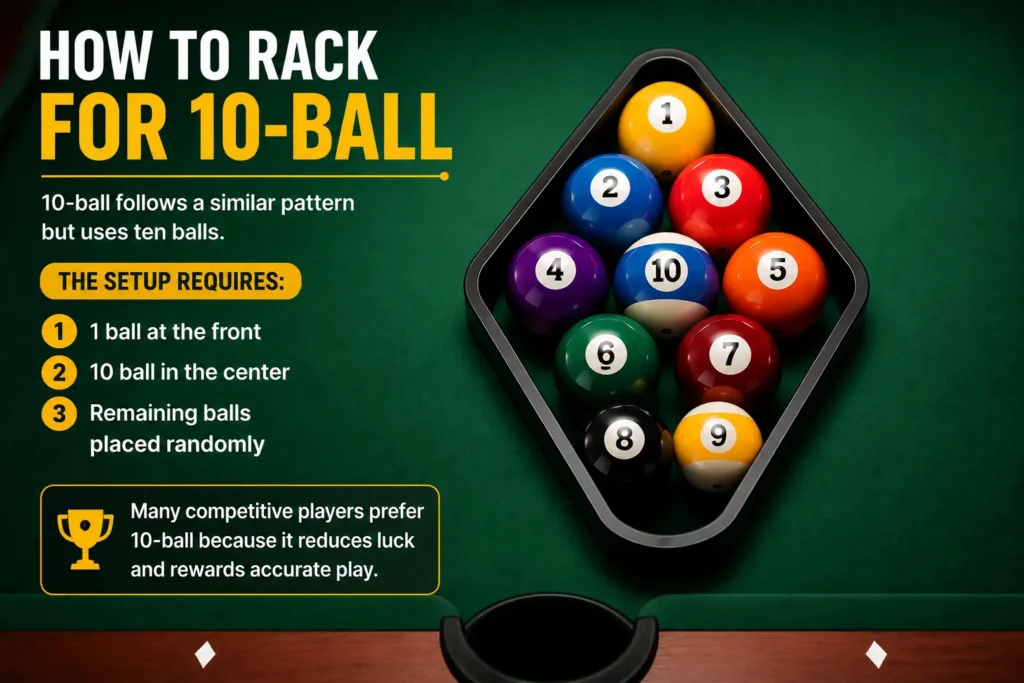
10-ball follows a similar pattern but uses ten balls.
The setup requires:
- 1 ball at the front
- 10 ball in the center
- Remaining balls placed randomly
Many competitive players prefer 10-ball because it reduces luck and rewards accurate play.
How to Build a Tight Rack
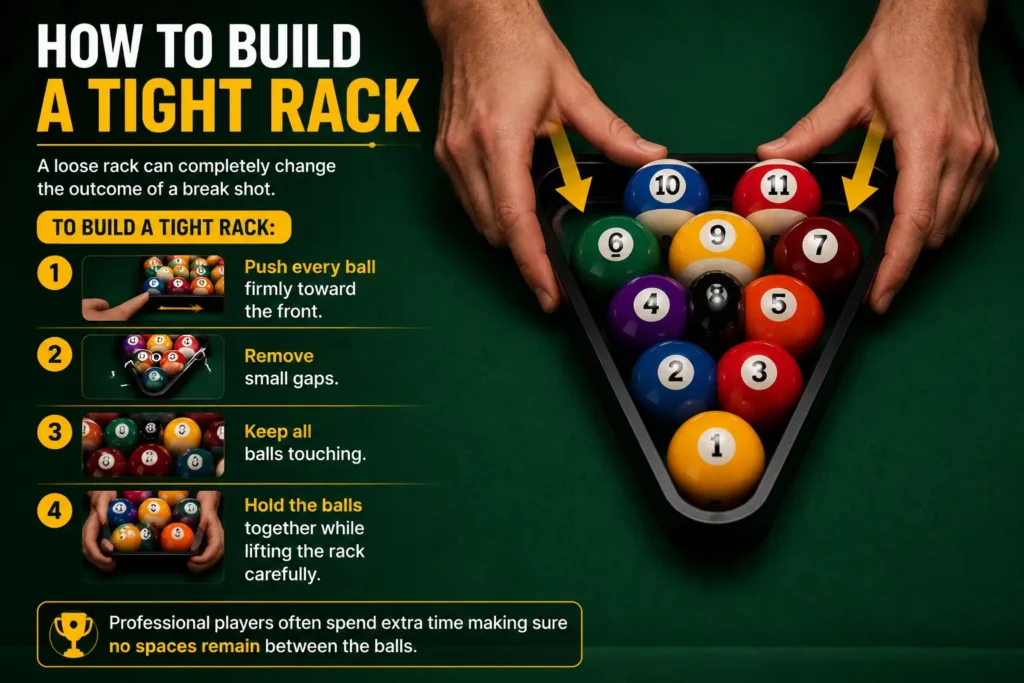
A loose rack can completely change the outcome of a break shot.
To build a tight rack:
- Push every ball firmly toward the front.
- Remove small gaps.
- Keep all balls touching.
- Hold the balls together while lifting the rack carefully.
Professional players often spend extra time making sure no spaces remain between the balls.
Common Mistakes Beginners Make
Many new players accidentally create unfair racks.
Some common mistakes include:
Leaving Gaps
Even tiny spaces reduce the power of the break.
Wrong Ball Placement
Putting the 8 ball in the wrong position or forgetting the 9 ball belongs in the center are common beginner errors.
Crooked Rack
If the triangle isn’t straight, the balls won’t spread evenly after the break.
Not Centering the Rack
Always make sure the front ball sits directly on the foot spot.
Should the Balls Be Random?
Yes—with certain exceptions.
Official rules only specify the positions of a few balls.
For example:
8-Ball
- 1 ball at the front
- 8 ball in the center
- Opposite rear corners must contain one solid and one stripe
Everything else can be random.
The same idea applies to 9-ball and 10-ball after placing the required balls.
Tips for a Better Break
A good rack and a good break work together.
To improve your break:
- Keep the cue level.
- Hit the head ball squarely.
- Use a controlled but powerful stroke.
- Follow through after contact.
- Aim for maximum accuracy instead of raw power.
Many skilled players rely more on technique than strength.
Practice Makes Racking Easier
Like any billiards skill, building a perfect rack becomes easier with practice.
Spend a few minutes before each game checking:
- Ball placement
- Tightness
- Triangle alignment
- Foot spot positioning
After several games, creating a tournament-quality rack becomes second nature.
Official Tournament Rules to Remember
Although local rules may vary slightly, most organized competitions follow these guidelines:
- The apex ball starts on the foot spot.
- Balls must touch each other.
- The rack must remain straight.
- Required numbered balls stay in their official positions.
- Players should not intentionally create loose racks.
Learning these rules prepares you for league and tournament play.
Final Thoughts
Knowing how to rack pool balls correctly helps create fair, enjoyable games while improving the quality of every break shot. Whether you’re playing 8-ball with friends or practicing for competitive tournaments, taking the time to build a tight, accurate rack makes a noticeable difference. Once you understand the correct ball positions and avoid common mistakes, you’ll start every game with confidence and consistency.
FAQs
1. Which ball goes first in the rack?
The 1 ball is placed at the front on the foot spot.
2. Where does the 8 ball go?
The 8 ball belongs in the center of the triangle during 8-ball games.
3. Do all the balls need to touch?
Yes. A tight rack ensures a fair and consistent break.
4. Can the other balls be random?
Yes, as long as the required balls remain in their correct positions.
5. Is a diamond rack better than a triangle?
A diamond rack is used for 9-ball and 10-ball, while a triangle is used for 8-ball.
📚 Related Guides
Enjoy learning new skills? Check out these helpful step-by-step guides: