
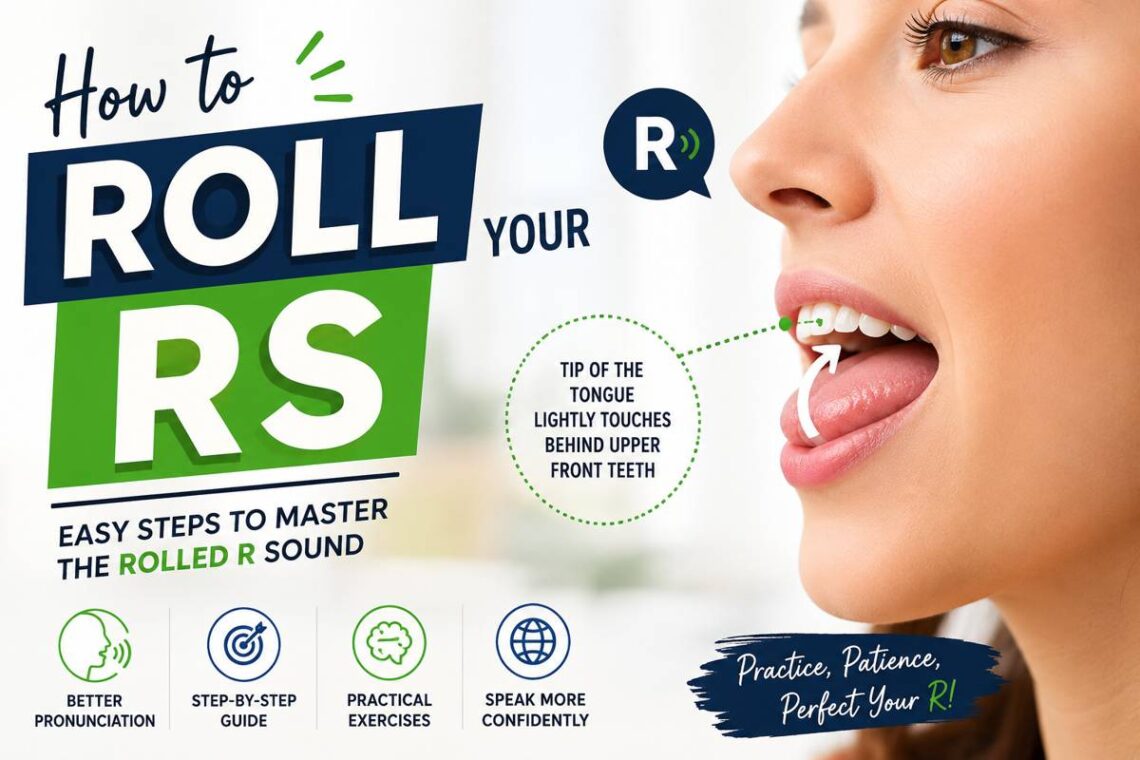
Rolling your R sound is one of the most challenging pronunciation skills for many language learners. If you’ve ever tried speaking Spanish, Italian, Russian, Arabic, or Scottish English, you’ve probably encountered the famous rolled R, also called the trilled R. While it may seem impossible at first, the ability to roll your R is a skill that most people can learn with patience and consistent practice.
Many beginners assume rolling their R is something you’re either born able to do or not. In reality, most people simply need to train the muscles in their tongue and learn the correct tongue placement. With the right exercises and enough repetition, many learners gradually develop the trill over time.
In this guide, you’ll learn how to roll your rs, why it can be difficult, the correct tongue position, simple daily exercises, common mistakes to avoid, and practical tips that can help you improve faster.
What Does It Mean to Roll Your Rs?
A rolled R, also known as an alveolar trill, is produced when the tip of your tongue vibrates rapidly against the roof of your mouth just behind your upper front teeth.
Unlike the English R, which is produced without tongue vibration, the rolled R creates a repeated tapping sound caused by airflow moving the tongue naturally.
Languages that commonly use a rolled R include:
- Spanish
- Italian
- Russian
- Arabic (in many dialects)
- Scottish English
- Welsh
Learning this sound improves both pronunciation and listening comprehension in many languages.
Why Is Rolling Your Rs Difficult?
There are several reasons why people struggle.
These include:
- Never using the trill in their native language.
- Keeping the tongue too stiff.
- Using too much muscle tension.
- Incorrect tongue placement.
- Blowing either too much or too little air.
The good news is that these problems can usually be corrected with regular practice.
Can Everyone Learn to Roll Their Rs?
Most people can learn with practice.
However, the amount of time varies from person to person.
Some learners succeed within a few days, while others may need several weeks or even months of daily practice.
In rare cases, certain physical conditions affecting the tongue or mouth may make rolling the R more difficult. If you suspect this applies to you, a speech-language pathologist can provide personalized guidance.
Understanding the Correct Tongue Position
Before practicing, it’s important to understand where your tongue should rest.
The tip of your tongue should lightly touch the small ridge just behind your upper front teeth. This area is called the alveolar ridge.
Your tongue should remain relaxed rather than pressing firmly against the roof of your mouth.
The vibration happens because air passes over the relaxed tongue—not because you force it to shake.
How to Roll Your Rs
Follow these beginner-friendly steps.
Step 1: Relax Your Tongue

Tension is the biggest obstacle.
Open your mouth slightly and let your tongue rest comfortably.
Avoid pressing it tightly against the roof of your mouth.
Step 2: Find the Correct Spot
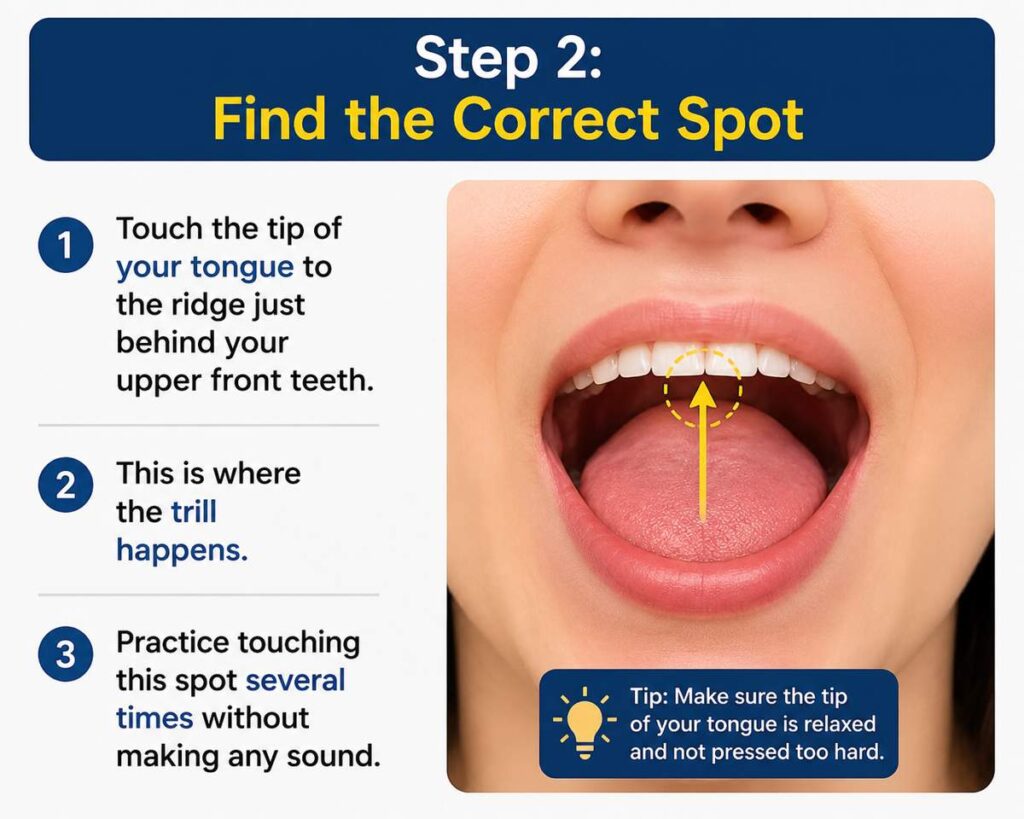
Touch the tip of your tongue to the ridge just behind your upper front teeth.
This is where the trill happens.
Practice touching this spot several times without making any sound.
Step 3: Blow Gentle Air
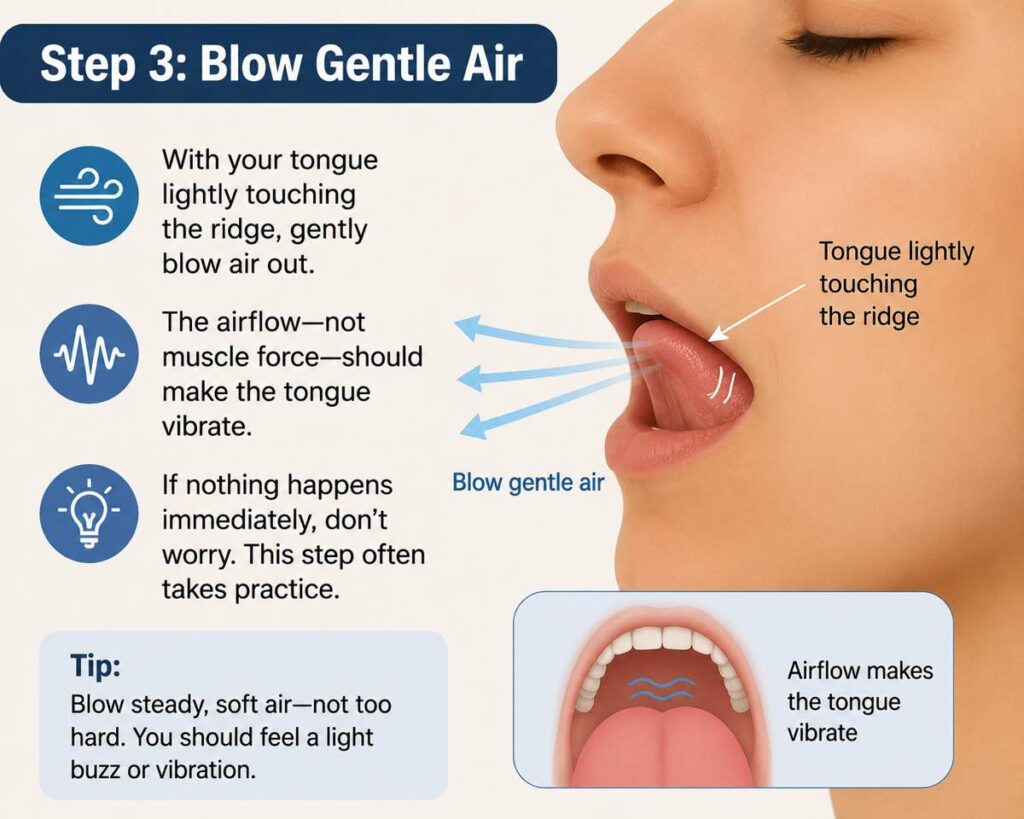
With your tongue lightly touching the ridge, gently blow air out.
The airflow—not muscle force—should make the tongue vibrate.
If nothing happens immediately, don’t worry. This step often takes practice.
Step 4: Practice the Single Tap
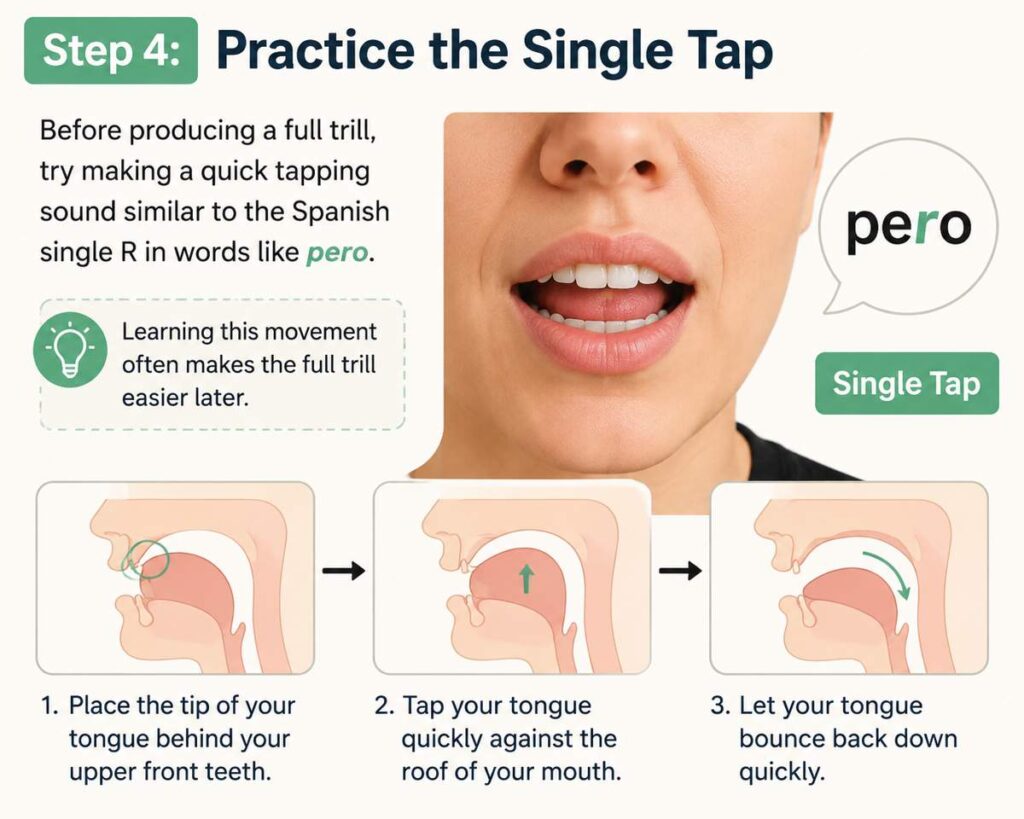
Before producing a full trill, try making a quick tapping sound similar to the Spanish single R in words like pero.
Learning this movement often makes the full trill easier later.
Step 5: Repeat Short Practice Sessions
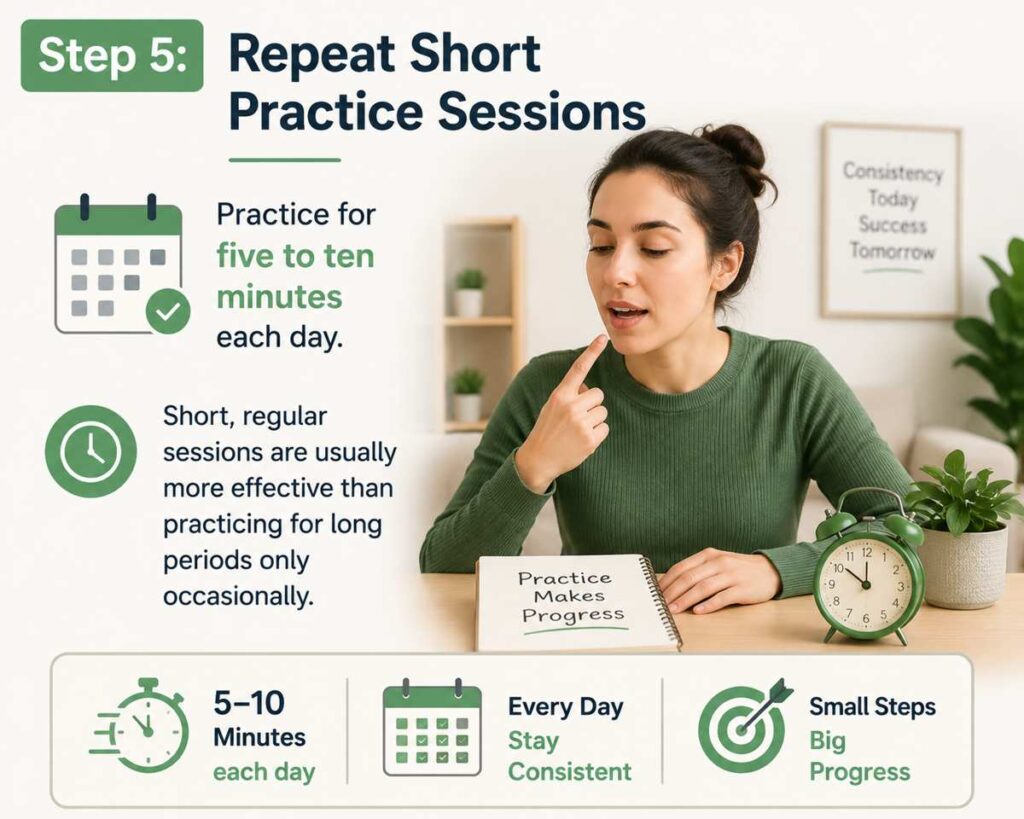
Practice for five to ten minutes each day.
Short, regular sessions are usually more effective than practicing for long periods only occasionally.
Exercises That Can Help
Simple exercises strengthen tongue control and improve coordination.
Repeat “D” and “T” Sounds
Say:
- da-da-da-da
- ta-ta-ta-ta
Gradually increase your speed while keeping your tongue relaxed.
Practice “Butter” (American English)
In many American accents, the tt in “butter” sounds like a quick tongue tap.
Repeating this sound can help you become familiar with the tongue movement needed for a trill.
Blow Air While the Tongue Is Relaxed
Lightly place your tongue against the alveolar ridge and gently exhale.
Avoid forcing the vibration.
Try Easy Syllables
Practice combinations such as:
- ra
- re
- ri
- ro
- ru
Focus on keeping your tongue loose rather than trying to produce a perfect trill immediately.
Common Mistakes
Many learners unknowingly make the process harder.
Pressing Too Hard
A tense tongue cannot vibrate freely.
Use only light contact with the roof of your mouth.
Blowing Too Much Air
Too much airflow may push the tongue away instead of creating a trill.
Gentle, steady air works best.
Giving Up Too Soon
Developing new speech movements takes time.
Daily practice usually produces better results than occasional long sessions.
Trying to Force the Sound
The trill is created naturally by airflow.
You cannot make it happen simply by shaking your tongue with muscle effort.
Words to Practice
Once you begin producing a trill, practice with simple words.
Spanish examples:
- perro
- rojo
- arroz
- rápido
Italian examples:
- Roma
- carro
- ferro
Start slowly and focus on pronunciation rather than speed.
How Long Does It Take?
There is no fixed timeline.
Some learners notice progress within a week.
Others need several months of consistent practice.
Improvement depends on:
- Daily practice
- Relaxed tongue position
- Proper airflow
- Previous language experience
Consistency matters more than speed.
Tips for Faster Improvement
These habits can help you progress more efficiently:
- Practice every day.
- Record yourself to track improvement.
- Listen to native speakers.
- Speak slowly at first.
- Focus on quality rather than quantity.
- Stay relaxed during practice.
- Be patient with yourself.
Small improvements add up over time.
Final Thoughts
Learning how to roll your rs may seem challenging at first, but it’s a skill that improves with patience and consistent practice. Instead of trying to force the sound, focus on relaxing your tongue, placing it correctly, and letting gentle airflow create the vibration naturally. Even if progress feels slow, regular short practice sessions can make a noticeable difference over time. With persistence, many learners eventually develop a clear and confident rolled R that improves pronunciation across several languages.
FAQs
1. Why can’t I roll my Rs?
Many people simply need more practice with tongue placement and airflow. It’s a learned skill for most learners.
2. How long does it take to learn?
Some people learn within days, while others may need several weeks or months of regular practice.
3. Is rolling your Rs necessary?
It depends on the language you’re learning. In some languages, proper pronunciation includes a rolled R.
4. Can adults learn to roll their Rs?
Yes. Adults can learn this skill through regular practice and patience.
5. Should I practice every day?
Yes. Five to ten minutes of daily practice is usually more effective than occasional long sessions.