
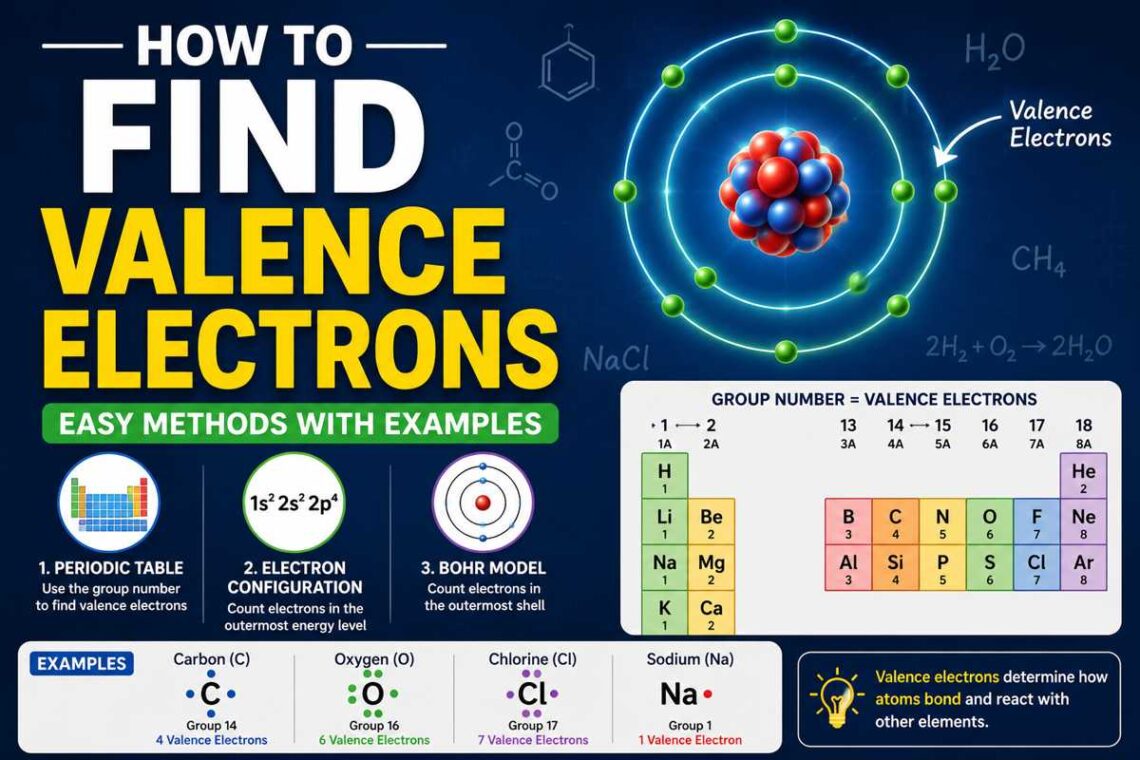
Understanding atoms is one of the first steps toward learning chemistry, and one of the most important concepts is knowing how to identify valence electrons. These outermost electrons determine how elements react with one another, form chemical bonds, and create compounds that make up everything around us.
If you’re a student preparing for a chemistry exam, a parent helping with homework, or simply curious about science, learning how to find valence electrons doesn’t have to be complicated. Once you understand a few basic rules, you can determine the valence electrons of most elements quickly and confidently.
This guide explains the concept step by step, covers different methods, provides examples, and highlights common mistakes to avoid.
What Are Valence Electrons?
Valence electrons are the electrons located in the outermost energy level (or shell) of an atom. These electrons participate in chemical reactions and bonding with other atoms.
Because they are the outermost electrons, they are less tightly held by the nucleus than inner electrons. This makes them responsible for forming ionic bonds, covalent bonds, and metallic bonds.
For example:
- Hydrogen has 1 valence electron.
- Oxygen has 6 valence electrons.
- Carbon has 4 valence electrons.
Knowing the number of valence electrons helps predict how an element behaves chemically.
Why Valence Electrons Are Important
Valence electrons play a major role in chemistry because they determine an element’s chemical properties.
They help scientists predict:
- How atoms bond together
- Whether an element is reactive
- The types of compounds an element can form
- Electrical conductivity
- Chemical stability
Elements with full outer shells, such as the noble gases, are generally very stable and react less with other substances.
Understanding Electron Shells
Electrons are arranged in layers around the nucleus called energy levels or electron shells.
The first shell can hold up to 2 electrons, while the second shell can hold up to 8 electrons. Larger shells can hold even more.
For example:
Carbon (6 electrons)
- First shell: 2 electrons
- Second shell: 4 electrons
Since the second shell is the outermost shell, carbon has 4 valence electrons.
Method 1: Use the Periodic Table
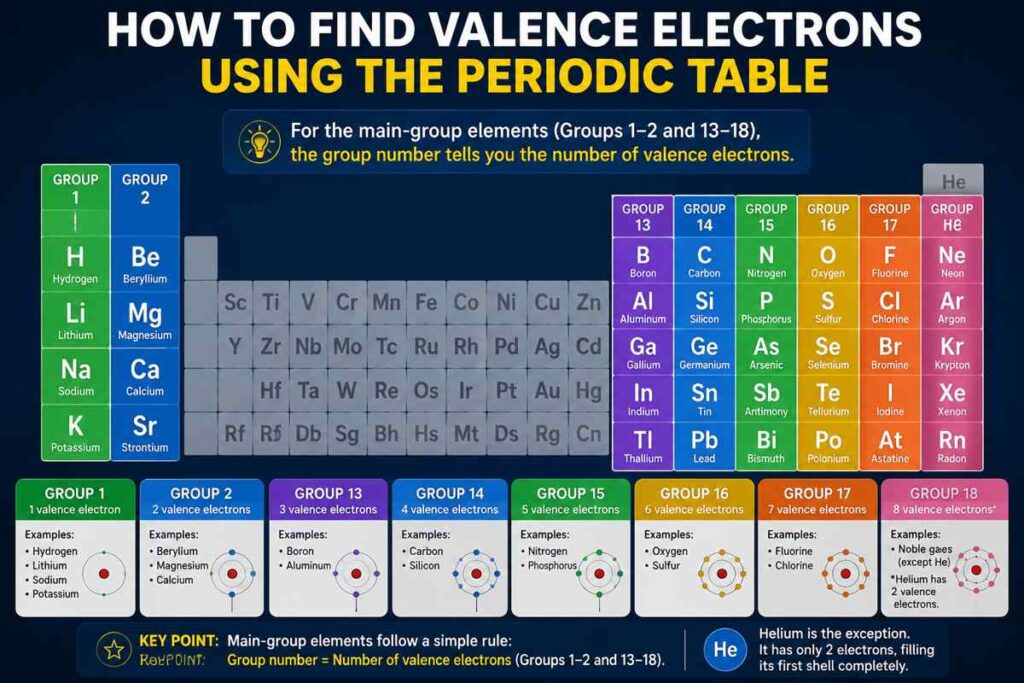
The easiest way to determine valence electrons for many elements is by using the periodic table.
For the main-group elements (Groups 1–2 and 13–18), the group number tells you the number of valence electrons.
Group 1
Examples:
- Hydrogen
- Lithium
- Sodium
- Potassium
Each has 1 valence electron.
Group 2
Examples:
- Beryllium
- Magnesium
- Calcium
Each has 2 valence electrons.
Group 13
These elements have 3 valence electrons.
Examples include:
- Boron
- Aluminum
Group 14
These elements have 4 valence electrons.
Examples:
- Carbon
- Silicon
Group 15
These elements contain 5 valence electrons.
Examples:
- Nitrogen
- Phosphorus
Group 16
These elements have 6 valence electrons.
Examples:
- Oxygen
- Sulfur
Group 17
These elements contain 7 valence electrons.
Examples:
- Fluorine
- Chlorine
Group 18
Most noble gases have 8 valence electrons, giving them very stable outer shells.
Helium is the exception because it has only 2 electrons, filling its first shell completely.
Method 2: Use Electron Configuration
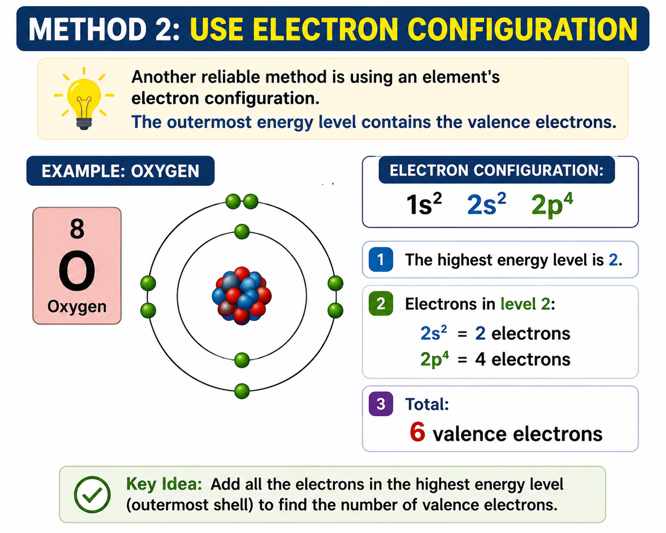
Another reliable method is using an element’s electron configuration.
The outermost energy level contains the valence electrons.
Example: Oxygen
Electron configuration:
1s² 2s² 2p⁴
The highest energy level is 2.
Electrons in level 2:
- 2s² = 2 electrons
- 2p⁴ = 4 electrons
Total:
6 valence electrons
Method 3: Draw a Bohr Model
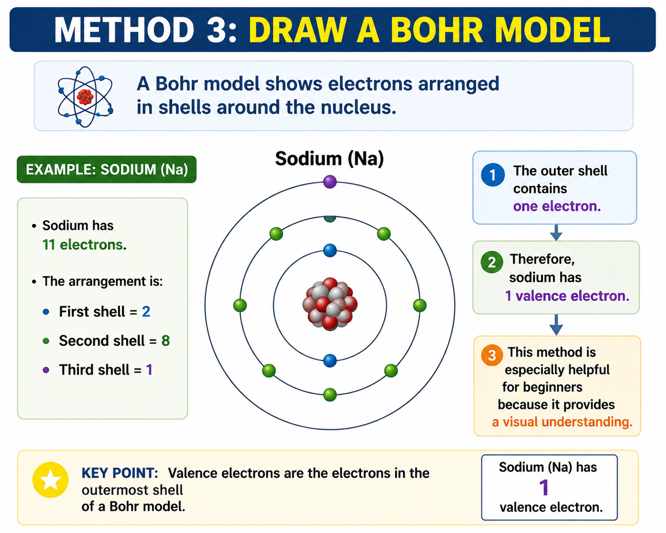
A Bohr model shows electrons arranged in shells around the nucleus.
For example, sodium has 11 electrons.
The arrangement is:
- First shell = 2
- Second shell = 8
- Third shell = 1
The outer shell contains one electron.
Therefore, sodium has 1 valence electron.
This method is especially helpful for beginners because it provides a visual understanding.
Examples of Finding Valence Electrons
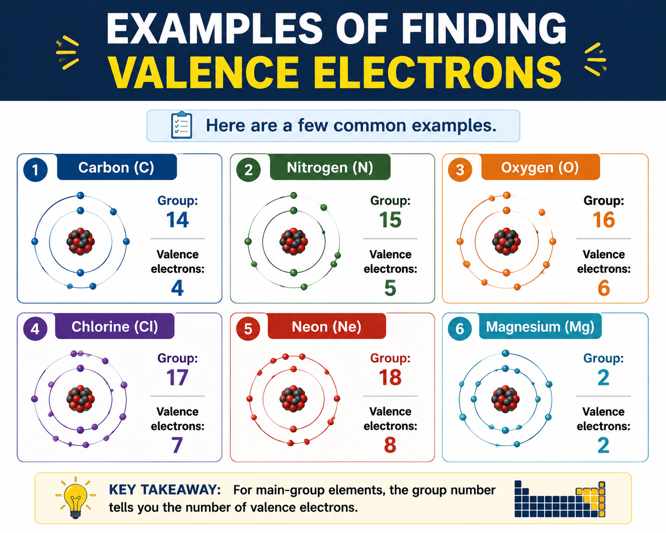
Here are a few common examples.
Carbon
Group: 14
Valence electrons: 4
Nitrogen
Group: 15
Valence electrons: 5
Oxygen
Group: 16
Valence electrons: 6
Chlorine
Group: 17
Valence electrons: 7
Neon
Group: 18
Valence electrons: 8
Magnesium
Group: 2
Valence electrons: 2
Transition Metals Are Different
Transition metals are located in the center of the periodic table (Groups 3–12).
Finding their valence electrons is more complex because electrons can occupy different energy levels depending on the chemical reaction.
In many introductory chemistry courses, students focus first on the main-group elements before studying transition metals in detail.
Common Mistakes Students Make
Learning chemistry becomes much easier if you avoid these common errors.
Confusing Total Electrons with Valence Electrons
An oxygen atom has 8 total electrons, but only 6 valence electrons.
Always count only the electrons in the outermost shell.
Forgetting About Helium
Helium belongs to Group 18 but has only 2 valence electrons, not eight.
It is still stable because its first shell is completely filled.
Misreading the Periodic Table
Make sure you’re using the correct group number for main-group elements.
The group—not the period—indicates the number of valence electrons.
Tips for Remembering Valence Electrons
Here are a few simple tricks that make memorization easier.
- Group 1 = 1 valence electron
- Group 2 = 2 valence electrons
- Group 13 = 3 valence electrons
- Group 14 = 4 valence electrons
- Group 15 = 5 valence electrons
- Group 16 = 6 valence electrons
- Group 17 = 7 valence electrons
- Group 18 = 8 valence electrons (except helium)
Practicing with the periodic table regularly will help these patterns become second nature.
Real-Life Importance of Valence Electrons
Valence electrons aren’t just important in chemistry classrooms—they play a role in many real-world applications.
Scientists use them to understand:
- Chemical reactions
- Drug development
- Material science
- Electronics and semiconductors
- Battery technology
- Environmental chemistry
Understanding valence electrons also helps explain why substances like table salt, water, and carbon dioxide form the way they do.
Final Thoughts
Learning how to find valence electrons is one of the most valuable foundational skills in chemistry. Whether you use the periodic table, electron configuration, or a Bohr model, the process becomes much easier with practice. By understanding where valence electrons are located and why they matter, you’ll be better prepared to study chemical bonding, reactions, and the behavior of elements.
Spend a little time practicing with different elements, and you’ll soon be able to identify valence electrons quickly and accurately.
FAQs
1. What are valence electrons?
Valence electrons are the electrons found in the outermost shell of an atom that participate in chemical bonding.
2. How can I find valence electrons using the periodic table?
For most main-group elements, the group number indicates the number of valence electrons.
3. Why are valence electrons important?
They determine how an element reacts with other elements and forms chemical bonds.
4. Do transition metals follow the same rule?
Not always. Transition metals have more complex electron arrangements and may require electron configuration to determine their valence electrons.
5. Does helium have eight valence electrons?
No. Helium has only two valence electrons, which completely fill its first energy level.