

Whether you’re completing a science experiment, solving a math assignment, or analyzing measurement results, understanding how to calculate percent error is an essential skill. Percent error tells you how close your measured or experimental value is to the accepted or true value. The smaller the percent error, the more accurate your measurement is.
Many students find percent error confusing at first because it involves comparing two values and applying a formula correctly. Fortunately, once you understand the process, calculating it becomes straightforward.
This guide explains the formula, walks through the calculation step by step, provides practical examples, highlights common mistakes, and answers frequently asked questions.
What Is Percent Error?
Percent error is a way of expressing the difference between an experimental value and an accepted (true) value as a percentage.
Scientists, students, engineers, and researchers use percent error to evaluate the accuracy of measurements.
A low percent error means your measured value is very close to the accepted value, while a higher percentage indicates a larger difference.
Why Is Percent Error Important?
Percent error helps determine the reliability of measurements.
It is commonly used in:
- Science laboratory experiments
- Chemistry calculations
- Physics measurements
- Engineering projects
- Quality control
- Manufacturing
- Educational assignments
Instead of simply knowing that two numbers are different, percent error shows how significant that difference is.
If you frequently work with numbers in spreadsheets, our guide on How to Sum a Column in Excel will help you calculate totals quickly and accurately.
Formula for Percent Error
The standard formula is:Percent Error=(Accepted Value∣Experimental Value−Accepted Value∣)×100%
Where:
- Experimental Value = Your measured result
- Accepted Value = The correct or known value
- Absolute Value = Ignore whether the difference is positive or negative
Always multiply the final decimal by 100 to convert it into a percentage.
Understanding the Formula
Before calculating, it’s helpful to understand each part.
Experimental Value
This is the value you measured during an experiment.
Example:
You measured the mass of an object as 48 grams.
Accepted Value
This is the known or correct value.
Example:
The actual mass is 50 grams.
Difference
Subtract the accepted value from the experimental value.
48 − 50 = −2
Since percent error uses the absolute value, the difference becomes 2.
Divide by the Accepted Value
2 ÷ 50 = 0.04
Multiply by 100
0.04 × 100 = 4%
The percent error is 4%.
Step-by-Step Guide
Follow these simple steps whenever calculating percent error.
Step 1: Identify Both Values

Write down:
- Experimental value
- Accepted value
Step 2: Find the Difference

Subtract one value from the other.
Ignore the negative sign by taking the absolute value.
Step 3: Divide by the Accepted Value

Always divide by the accepted value.
Step 4: Multiply by 100

Convert the decimal into a percentage.
Step 5: Write the Final Answer

Include the percent symbol.
Need to save your calculations digitally? Learn How to Convert Picture to PDF on iPhone and easily share worksheets or handwritten notes.
Example 1: Measuring Weight
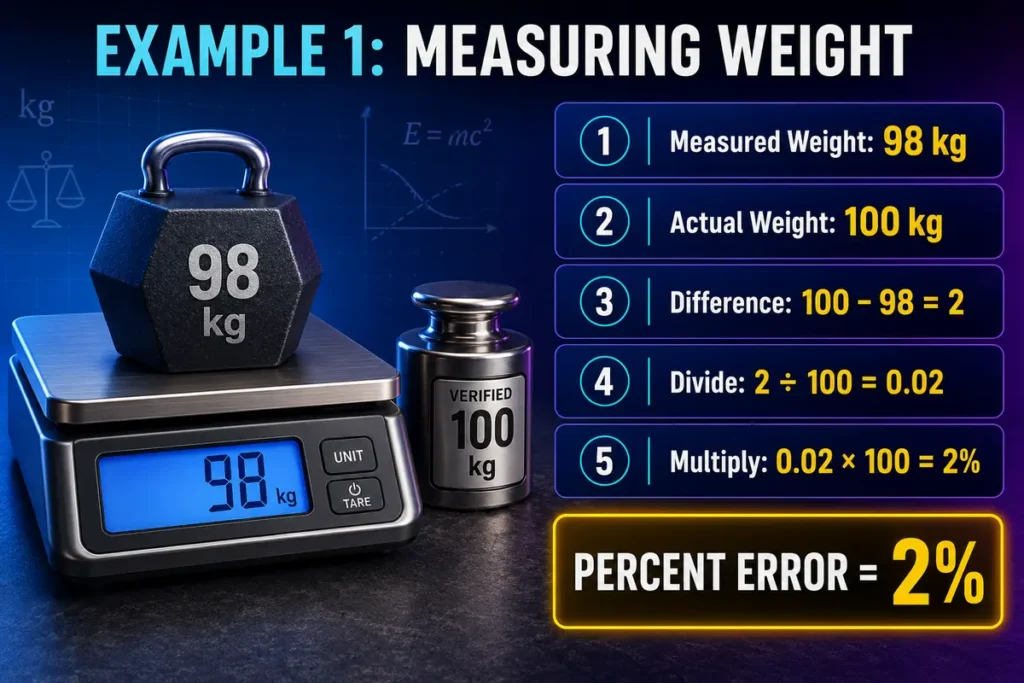
Suppose a scale measures an object as 98 kg, but the actual weight is 100 kg.
Difference:
100 − 98 = 2
Divide:
2 ÷ 100 = 0.02
Multiply:
0.02 × 100 = 2%
The percent error is 2%.
Example 2: Science Experiment
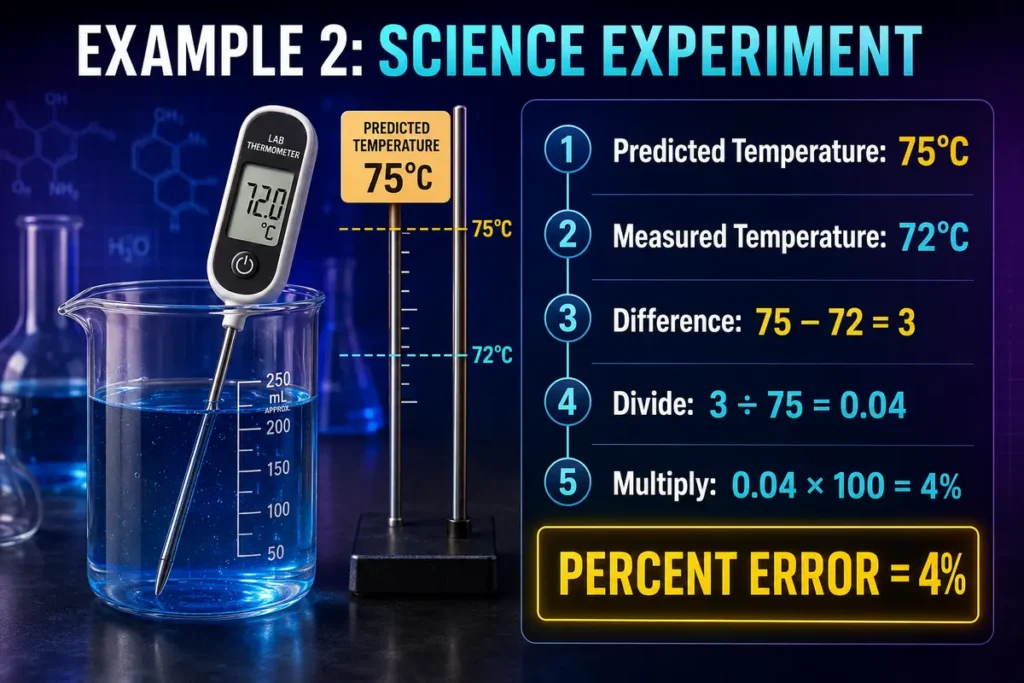
A chemistry experiment predicts a liquid temperature of 75°C.
Your experiment measures 72°C.
Difference:
75 − 72 = 3
Divide:
3 ÷ 75 = 0.04
Multiply:
0.04 × 100 = 4%
Percent error = 4%
Example 3: Distance Measurement
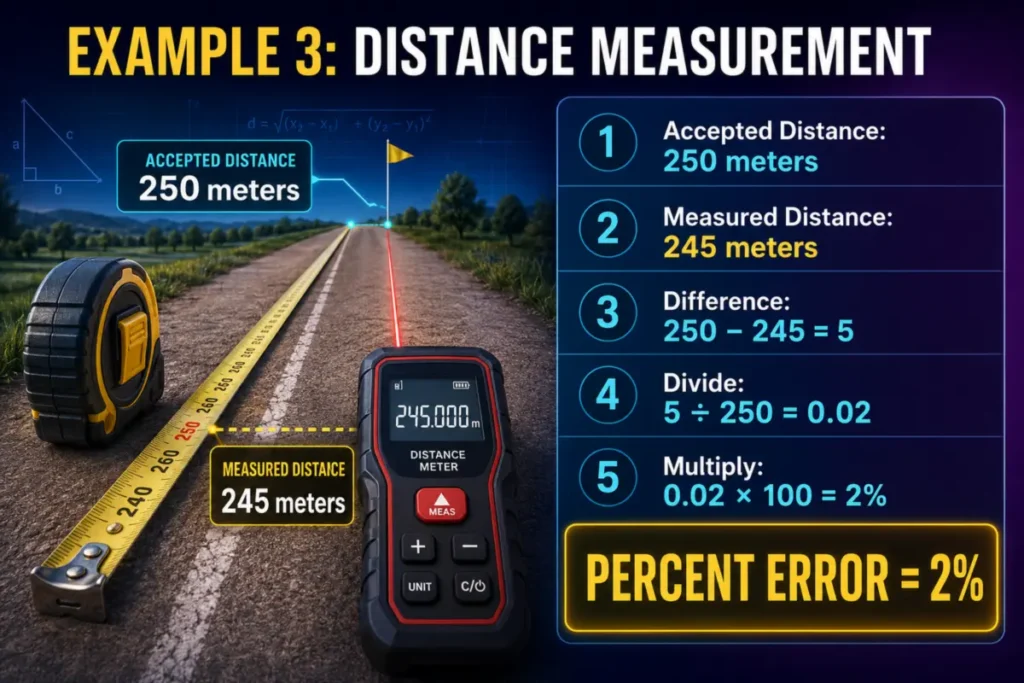
Accepted distance:
250 meters
Measured distance:
245 meters
Difference:
250 − 245 = 5
Divide:
5 ÷ 250 = 0.02
Multiply:
0.02 × 100 = 2%
What Is a Good Percent Error?
There isn’t one universal answer.
Generally:
- 0% = Perfect measurement
- Less than 5% = Very accurate
- 5–10% = Often acceptable
- Above 10% = May indicate significant measurement errors
Acceptable percent error depends on the experiment, industry, and level of precision required.
Common Causes of Percent Error
Several factors can increase percent error.
Examples include:
- Incorrect measurements
- Equipment calibration problems
- Human mistakes
- Reading instruments incorrectly
- Environmental conditions
- Rounding errors
Reducing these factors improves accuracy.
Common Mistakes to Avoid
Students frequently make these errors.
Forgetting the Absolute Value
Negative answers should become positive.
Dividing by the Wrong Number
Always divide by the accepted value—not the experimental value.
Forgetting to Multiply by 100
Without multiplying by 100, your answer remains a decimal instead of a percentage.
Using Incorrect Units
Both values must use the same unit before calculating.
For example:
- Both in grams
- Both in meters
- Both in degrees Celsius
After finishing your study session, take a break with our beginner-friendly cooking guide on How to Cook a Steak.
Percent Error vs Percent Difference
These terms sound similar but mean different things.
Percent Error
Compares:
- Experimental value
- Accepted value
Used when one value is known to be correct.
Percent Difference
Compares two measured values.
Neither value is considered the “correct” one.
Scientists use percent difference when comparing two experimental measurements.
Tips for More Accurate Results
To reduce percent error:
- Measure carefully.
- Double-check calculations.
- Use calibrated equipment.
- Record data accurately.
- Avoid rounding until the final answer.
- Repeat experiments when possible.
These practices improve the quality of your results.
Where Is Percent Error Used?
Percent error appears in many real-world situations.
Examples include:
- School science labs
- Medical research
- Engineering tests
- Manufacturing quality checks
- Environmental studies
- Physics experiments
- Chemistry laboratories
It helps professionals evaluate how accurate measurements are compared with expected results.
Final Thoughts
Knowing how to calculate percent error is an important skill for students, researchers, and professionals alike. By comparing your experimental value with the accepted value, you can quickly determine how accurate your measurements are. Remember to use the absolute difference, divide by the accepted value, and multiply by 100. With regular practice, calculating percent error becomes quick and easy, helping you analyze data more confidently in science, mathematics, and everyday problem-solving.
Looking for more technology tutorials? Follow our guide on How to Deactivate Facebook Account to manage your online privacy.
FAQs
1. What is percent error?
Percent error measures how much an experimental value differs from the accepted value as a percentage.
2. Can percent error be negative?
No. The absolute value is used, so percent error is always positive.
3. Why do we divide by the accepted value?
The accepted value serves as the standard for measuring accuracy.
4. What does a 0% percent error mean?
It means the experimental value exactly matches the accepted value.
5. Is a smaller percent error better?
Yes. A lower percent error indicates a more accurate measurement.
📚 Related Math & Productivity Guides
Looking for more helpful tutorials? Continue learning with these step-by-step guides: